
Using AI & Machine Learning to accurately detect retrotransposons, without any long-read sequencing
Surpassing the 1000 Genomes Project at retrotransposon detection
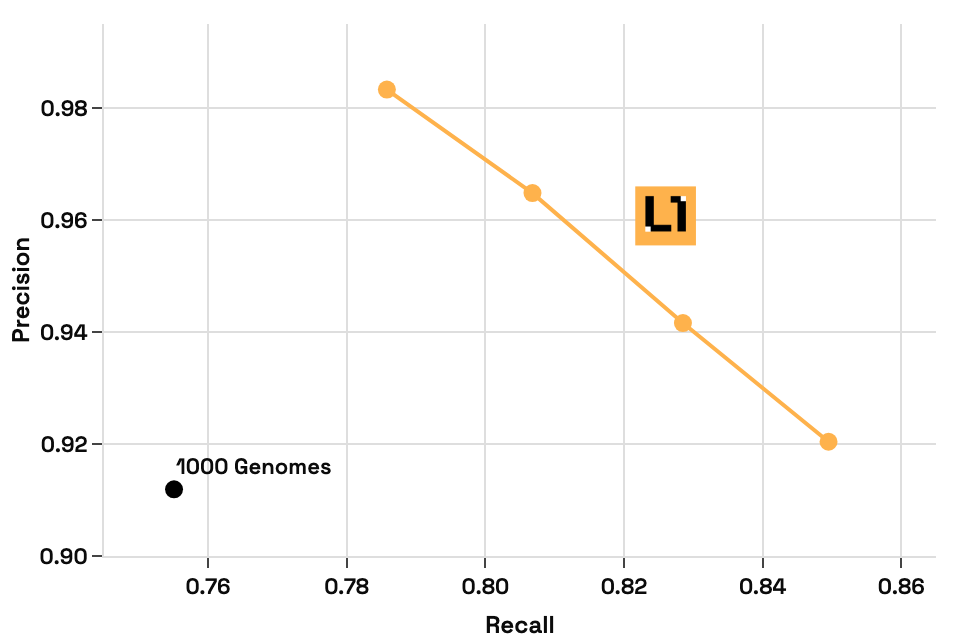
Our software has surpassed the 1000 Genomes Project in a performance benchmark measuring the accuracy of retrotransposon detection. Retrotransposons are virus-like elements inside your genome that activate in cancer, neurological and immunological diseases
It is possible to suppress retrotransposons, but first we need to know which diseases they activate in, when they activate over the time course of each disease, and what their relative contribution is to each disease
We can start answering these questions by observing retrotransposons copying themselves around the genome. This is how the Nobel Prize winner Barbara McClintock discovered retrotransposons in the 20th century - except she only had a microscope, not powerful genome sequencing technology
How were we able to detect retrotransposons copying themselves? Tools that detect them exist in academia, but most are no longer maintained and/or have restrictive licenses. They also predate large language models. So we developed a new tool from the ground up, leveraging data from the 1000 Genomes Project - a major multi-year academic consortium that produced the world's largest database of retrotransposons, and made its genomic data freely accessible to the public online
The 1000 Genomes used two sequencing technologies, Illumina and Oxford Nanopore Technologies (ONT). Our benchmark surpasses the 1000 Genomes using just Illumina's technology - a few weeks of work from two people, Amazon Web Services, Cursor, OpenAI & Grok. The software runs in about two hours per genome, faster than state-of-the-art tools from academia
It is much harder to detect retrotransposons than other kinds of mutations most people are familiar with. Sequencing technologies are not designed or optimized to detect them, and it is even harder to find them in diseased tissue, where there is so much complexity in the data and genomes can be over 100 gigabytes in size. With AI, individuals or small teams with deep domain expertise can reveal this hidden complexity - which enables us to continuously improve the algorithm as we scale up our analysis
Our algorithm outperforms the 1000 Genomes on both precision (the fraction of calls that are real) and recall (the fraction of real insertions detected). Making this evaluation was a painstaking process, involving manual inspection of retrotransposon insertions to determine what was real or not
The tool is open sourced on GitHub, and there are many ways we plan to improve it further
Have a question about this piece, or a collaboration in mind? Get in touch